 Add to Chrome
 Add to Firefox
 Add to Edge
Stage-adaptive Token Selection for Efficient Omni-modal LLMs
May 19, 2026
Omni-modal large language models (om-LLMs) achieve unified audio-visual understanding by encoding video and audio into temporally aligned token sequences interleaved at the window level. However, processing these dense non-textual tokens throughout the LLM incurs substantial computational overhead. Although training-free token selection can reduce this cost, existing methods either focus on visual-only inputs or prune om-LLM tokens only before the LLM with fixed per-modality ratios, failing to capture how cross-modal token importance evolves across layers. To address this limitation, we first analyze the layer-wise token dependency of om-LLMs. We find that visual and audio dependencies follow a block-wise pattern and gradually weaken with depth, indicating that many late-layer non-textual tokens become redundant after cross-modal fusion. Motivated by this observation, we propose SEATS, a training-free, stage-adaptive token selection method for efficient om-LLM inference. Before the LLM, SEATS removes spatiotemporal redundancy via attention-weighted diversity selection. Inside the LLM, it progressively prunes tokens across blocks and dynamically allocates the retention budget from temporal windows to modalities using query relevance scores. In late layers, it removes all remaining non-textual tokens once cross-modal fusion is complete. Experiments on Qwen2.5-Omni and Qwen3-Omni demonstrate that SEATS effectively improves inference efficiency. Retaining only 10% of visual and audio tokens, it achieves a 9.3x FLOPs reduction and a 4.8x prefill speedup while preserving 96.3% of the original performance.

OmniPro: A Comprehensive Benchmark for Omni-Proactive Streaming Video Understanding
May 18, 2026Omni-proactive streaming video understanding, i.e., autonomously deciding when to speak and what to say from continuous audio-visual streams, is an emerging capability of omni-modal large language models. Existing benchmarks fall short in three key aspects: they rely primarily on visual signals, adopt polling or fixed-timestamp protocols instead of true proactive evaluation, and cover only a limited range of tasks, preventing reliable assessment and differentiation of omni-proactive streaming models. We present OmniPro, the first benchmark to jointly evaluate omni-modal perception, proactive responding, and diverse video understanding tasks. It comprises 2,700 human-verified samples spanning 9 sub-tasks and 3 cognitive levels, covering 6 basic video understanding capabilities. Notably, 84% of samples require audio signals (speech or non-speech), and each sample is annotated with modality-isolation labels to enable fine-grained multimodal analysis. We further introduce a dual-mode evaluation protocol: Probe mode assesses content understanding by querying the model before and after each ground-truth trigger, while Online mode evaluates full proactive ability by requiring models to autonomously decide when to respond in streaming input. Evaluating 11 representative models reveals three key findings: (1) audio provides consistent gains but with highly variable utilization across models, (2) performance degrades significantly over time, indicating limited long-horizon robustness, and (3) non-speech audio perception remains the weakest dimension.
SAVE: Speech-Aware Video Representation Learning for Video-Text Retrieval
Mar 11, 2026For video-text retrieval, the use of CLIP has been a de facto choice. Since CLIP provides only image and text encoders, this consensus has led to a biased paradigm that entirely ignores the sound track of videos. While several attempts have been made to reintroduce audio -- typically by incorporating an audio encoder and fusing its output with visual features -- these methods face two challenges: ineffective representation of speech content and suboptimal vision-audio fusion. To address these issues jointly, we propose SAVE, a Speech Aware Video rEpresentation learning method. SAVE improves upon AVIGATE, a SOTA audiovisual method, with a dedicated speech branch for more effective speech embedding. Furthermore, we introduce soft-ALBEF for early vision-audio alignment that facilitates fusion. Extensive experiments on five benchmarks show that SAVE compares favorably against the SOTA, outperforming AVIGATE by +4.1% on MSRVTT-9k, +1.9% on MSRVTT-7k, +2.5% on VATEX, +9.8% on Charades, and +2.1% on LSMDC, in light of the SumR metric.
Hybrid-Tower: Fine-grained Pseudo-query Interaction and Generation for Text-to-Video Retrieval
Sep 05, 2025The Text-to-Video Retrieval (T2VR) task aims to retrieve unlabeled videos by textual queries with the same semantic meanings. Recent CLIP-based approaches have explored two frameworks: Two-Tower versus Single-Tower framework, yet the former suffers from low effectiveness, while the latter suffers from low efficiency. In this study, we explore a new Hybrid-Tower framework that can hybridize the advantages of the Two-Tower and Single-Tower framework, achieving high effectiveness and efficiency simultaneously. We propose a novel hybrid method, Fine-grained Pseudo-query Interaction and Generation for T2VR, ie, PIG, which includes a new pseudo-query generator designed to generate a pseudo-query for each video. This enables the video feature and the textual features of pseudo-query to interact in a fine-grained manner, similar to the Single-Tower approaches to hold high effectiveness, even before the real textual query is received. Simultaneously, our method introduces no additional storage or computational overhead compared to the Two-Tower framework during the inference stage, thus maintaining high efficiency. Extensive experiments on five commonly used text-video retrieval benchmarks demonstrate that our method achieves a significant improvement over the baseline, with an increase of $1.6\% \sim 3.9\%$ in R@1. Furthermore, our method matches the efficiency of Two-Tower models while achieving near state-of-the-art performance, highlighting the advantages of the Hybrid-Tower framework.
Multi-Object Sketch Animation by Scene Decomposition and Motion Planning
Mar 25, 2025Sketch animation, which brings static sketches to life by generating dynamic video sequences, has found widespread applications in GIF design, cartoon production, and daily entertainment. While current sketch animation methods perform well in single-object sketch animation, they struggle in multi-object scenarios. By analyzing their failures, we summarize two challenges of transitioning from single-object to multi-object sketch animation: object-aware motion modeling and complex motion optimization. For multi-object sketch animation, we propose MoSketch based on iterative optimization through Score Distillation Sampling (SDS), without any other data for training. We propose four modules: LLM-based scene decomposition, LLM-based motion planning, motion refinement network and compositional SDS, to tackle the two challenges in a divide-and-conquer strategy. Extensive qualitative and quantitative experiments demonstrate the superiority of our method over existing sketch animation approaches. MoSketch takes a pioneering step towards multi-object sketch animation, opening new avenues for future research and applications. The code will be released.
ASR-enhanced Multimodal Representation Learning for Cross-Domain Product Retrieval
Aug 06, 2024
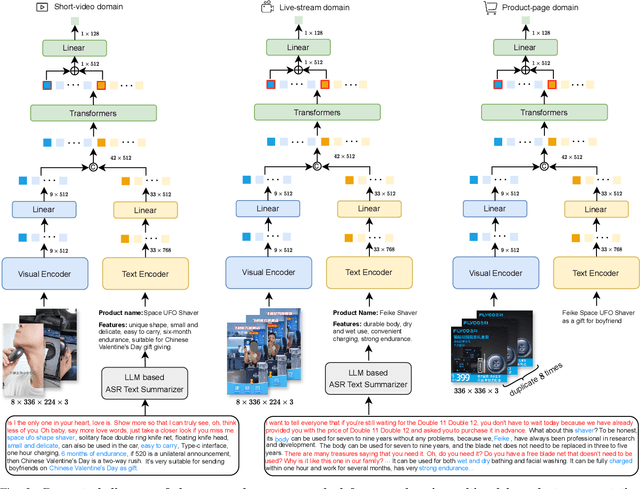
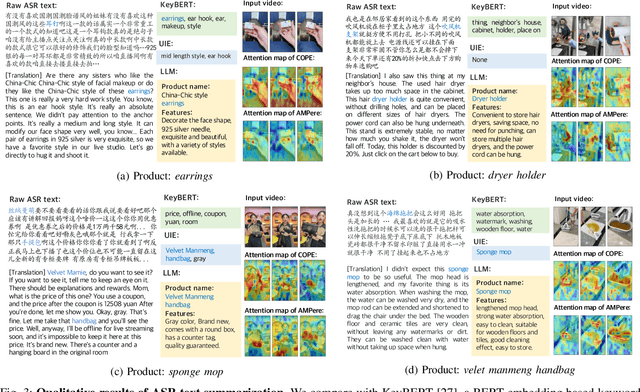

E-commerce is increasingly multimedia-enriched, with products exhibited in a broad-domain manner as images, short videos, or live stream promotions. A unified and vectorized cross-domain production representation is essential. Due to large intra-product variance and high inter-product similarity in the broad-domain scenario, a visual-only representation is inadequate. While Automatic Speech Recognition (ASR) text derived from the short or live-stream videos is readily accessible, how to de-noise the excessively noisy text for multimodal representation learning is mostly untouched. We propose ASR-enhanced Multimodal Product Representation Learning (AMPere). In order to extract product-specific information from the raw ASR text, AMPere uses an easy-to-implement LLM-based ASR text summarizer. The LLM-summarized text, together with visual data, is then fed into a multi-branch network to generate compact multimodal embeddings. Extensive experiments on a large-scale tri-domain dataset verify the effectiveness of AMPere in obtaining a unified multimodal product representation that clearly improves cross-domain product retrieval.
TeachCLIP: Multi-Grained Teaching for Efficient Text-to-Video Retrieval
Aug 02, 2023For text-to-video retrieval (T2VR), which aims to retrieve unlabeled videos by ad-hoc textual queries, CLIP-based methods are dominating. Compared to CLIP4Clip which is efficient and compact, the state-of-the-art models tend to compute video-text similarity by fine-grained cross-modal feature interaction and matching, putting their scalability for large-scale T2VR into doubt. For efficient T2VR, we propose TeachCLIP with multi-grained teaching to let a CLIP4Clip based student network learn from more advanced yet computationally heavy models such as X-CLIP, TS2-Net and X-Pool . To improve the student's learning capability, we add an Attentional frame-Feature Aggregation (AFA) block, which by design adds no extra storage/computation overhead at the retrieval stage. While attentive weights produced by AFA are commonly used for combining frame-level features, we propose a novel use of the weights to let them imitate frame-text relevance estimated by the teacher network. As such, AFA provides a fine-grained learning (teaching) channel for the student (teacher). Extensive experiments on multiple public datasets justify the viability of the proposed method.